
 By
By 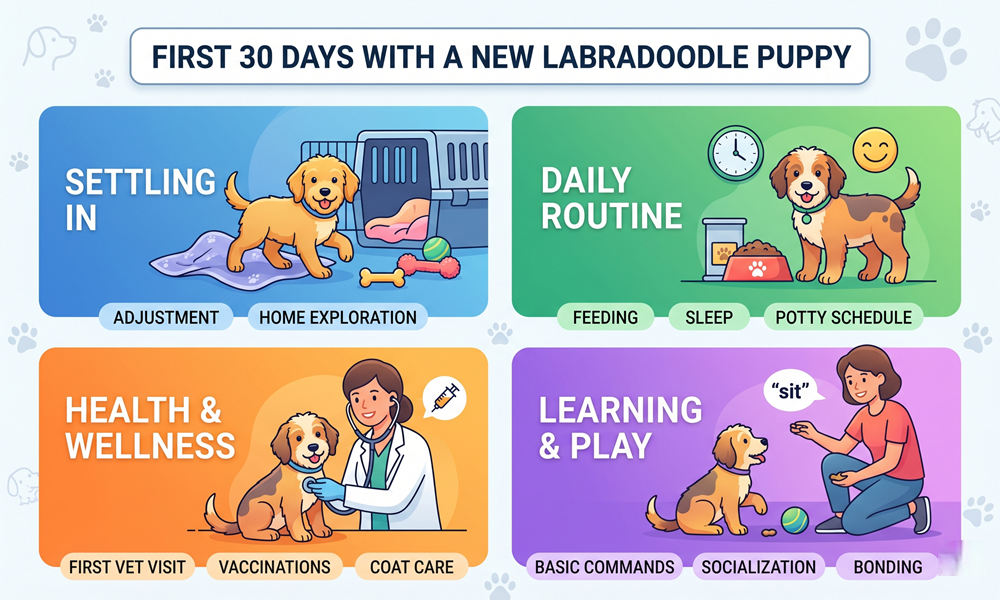
The first month with a new Labradoodle puppy is one of the most rewarding and most disruptive periods you will experience as a dog owner. Labradoodles are bright, social, and eager to engage, which makes training them genuinely enjoyable. They are also puppies, which means they will test boundaries, sleep in unpredictable patterns, occasionally howl at night, chew things they should not, and generally require far more active attention than most new owners anticipate.
Knowing what to expect week by week removes a great deal of the stress and replaces it with realistic preparation. What follows is an honest guide to the first thirty days.
Before the Puppy Arrives: Preparation That Pays Off
The work you do before your puppy comes home sets the tone for everything that follows. Puppy-proof your home by removing anything at floor level that should not be chewed, swallowed, or knocked over. Cables, shoes, children’s toys, and household plants all need to be out of reach or in closed rooms. Set up the crate in a quiet but family-accessible location before the puppy arrives so it is a familiar object rather than a surprise. Have your vet appointment booked for the first week, your food supply ready, and a consistent feeding schedule planned before day one.
The crate is worth special attention because it is the single most useful tool in the first thirty days. A correctly introduced crate is not a punishment space. It is the puppy’s own secure area, and establishing it as a positive environment early makes housetraining, nighttime settling, and calm behaviour significantly easier to achieve.
Week One: Adjustment and Overwhelm (For Both of You)
The first week is primarily about the puppy adjusting to an entirely new environment. They have left their mother, their littermates, and every familiar smell and sound. Some puppies settle quickly; others take several days to find their footing. Expect broken nights for at least the first week, possibly two. The puppy does not yet understand the household routine, and the anxiety of being separated from its litter expresses itself most loudly at night. This is normal and temporary. Well-socialised Labradoodle puppies that have been raised in a home environment from birth tend to adjust faster because the sounds, smells, and presence of a busy household are already familiar to them.
During week one, keep visitors to a minimum and avoid overwhelming the puppy with new experiences. Your primary goal is making the puppy feel safe and building positive associations with the crate, the family, and the home space. Short, positive interactions with each family member, calm handling, and consistent routines for feeding and toilet breaks are the entire agenda for this week.
Week Two: Establishing Routine and Starting Basic Training
By week two most puppies begin to show their personality more clearly and start to anticipate the household routine. This is the right time to begin very basic training: name recognition, sit, and the beginnings of lead acceptance. Labradoodles are eager learners and respond extremely well to positive reinforcement. Short sessions of three to five minutes, several times a day, are more effective than longer sessions at this age.
Housetraining should be in full swing by now. Take the puppy outside immediately after every meal, every sleep, and every play session. Reward outdoor toileting with calm, genuine praise. Accidents inside are part of the process and should be cleaned without drama. Shouting or punishment during housetraining is counterproductive and damages the trust you are working to build.
Weeks Three and Four: Growing Confidence and Testing Limits
Weeks three and four often bring the first real tests of your training consistency. The puppy is more confident, more energetic, and beginning to understand that certain behaviours produce reactions from humans. This is when mouthing and nipping become more noticeable, when jumping up becomes a habit if not addressed, and when the puppy starts to push boundaries around what it is allowed to access.
Redirect rather than punish. When the puppy mouths your hand, replace your hand with an appropriate chew toy and praise the transition. When it jumps up, turn away and withdraw attention until four paws are on the floor, then greet calmly. These responses need to be consistent across every person in the household. One family member allowing jumping while another corrects it teaches the puppy to read people rather than learn the rule.
By day thirty a well-handled Labradoodle puppy should be sleeping reliably through the night, making good progress with housetraining, responding to its name consistently, and beginning to show genuine engagement with basic commands. It will not be perfectly trained. It will be a puppy that is clearly heading in the right direction with a solid foundation beneath it.
The quality of the first thirty days is shaped significantly by the foundation the puppy brings with it from the breeder. A puppy that has been well socialised, vet-checked, and prepared for home life settles faster and trains more easily. Reviewing the full breeder support and adoption process before committing to a puppy gives you a clear picture of what responsible early-life care looks like, and what ongoing support a good breeder continues to provide long after your puppy comes home.









Comments