
 By
By 
You can usually tell which dogs have been before. There’s one flattened against the door of the waiting room with his owner apologising to nobody in particular, one hiding under a chair, and one being walked in circles because he won’t sit down.
Then a name gets called and somebody has to half-carry a spaniel through a door he has very clearly decided he isn’t going through.
It’s such a familiar scene that most owners have accepted it as the cost of doing business. It doesn’t have to be, and the approach that changes it is neither complicated nor expensive – it just has to start well before the appointment.
Why it goes wrong
The mechanism is worth understanding because it explains why things get worse year on year rather than better.
A dog arrives, is frightened, and struggles. Somebody holds him still so the job can be done, because the job does genuinely need doing. He struggles harder, so he’s held more firmly. The examination finishes, he goes home, and what he has learned is that the smell of that building predicts being held down by strangers while unable to escape.
Next visit he’s more worried at the door, so the restraint starts earlier and is a bit firmer. Within three or four visits you’ve built a dog who needs two nurses and a towel, and everybody involved has a horrible time.
The other thing that happens is single-event learning. One genuinely frightening experience – a painful procedure, a slip off a table, a muzzle jammed on in a hurry – can shape a dog’s opinion of veterinary practices for the rest of his life. Fear learns fast, which is exactly what it’s for.
Which means the work has to happen outside the consulting room. A pre-visit routine that lowers the starting point does far more than anything you can manage in the two minutes before you’re called: a quiet morning rather than a big walk, a light meal, high-value food in your pocket, and something like Relaxing Dog Treats given with enough lead time to actually be working by the time you arrive rather than pressed into his mouth in the car park.
Cooperative care: the basic idea
The principle is close to counterintuitive. Give the dog a clear way to say no, and he will say yes considerably more often.
A dog with no way out struggles, because struggling is the only option available. A dog who has learned that stillness makes the handling continue and that moving away makes it stop has been handed a lever, and dogs who have a lever tend to use it far less than you’d expect. What removes the panic is having the choice, not the choosing.
In practice that means teaching a position that means “I’m ready” and treating any break in that position as a full stop rather than something to work through. It takes a few weeks of two-minute sessions and it transforms the whole business.
Start at home
Long before any of this touches a vet, get the handling itself boring.
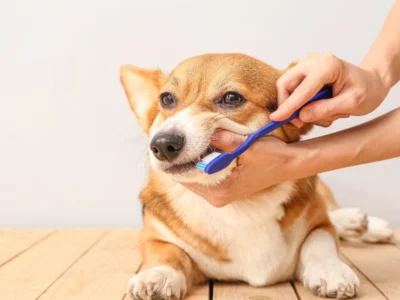
Sit on the floor with something excellent to eat. Touch an ear for one second, feed. Touch a paw for one second, feed. That’s the whole exercise, and the errors people make are always the same two: going too long, and going too fast up the difficulty scale.
Build it slowly. Ear touched, ear held, ear lifted, ear looked into. Paw touched, paw held, paw held for five seconds, nail touched, clipper touched to nail without cutting. Mouth touched, lip lifted, lip lifted with a look at the teeth.
Do a couple of minutes a day, in front of the television, without ceremony. The aim is a dog for whom having his ears looked at is about as interesting as being asked to sit.
The chin rest
This is the single most useful thing to teach, and it’s the consent signal that makes the rest work.
Hold your palm out flat. The moment his chin makes contact, mark it and feed. Build up to him holding the position for a few seconds, then longer.
Then start adding the handling while he’s resting his chin – an ear check, a paw lift, a hand on his side. If he lifts his chin, everything stops instantly, no comment, no persuasion. When he puts it back, you resume.
Dogs work this out remarkably quickly. What you end up with is a dog who actively offers a position that means “get on with it”, which is a very different animal from one who tolerates being held.
Muzzle training, before you need it
Worth doing with every dog and worth doing now, when there’s no reason to.
A muzzle introduced calmly over three weeks with food is a piece of equipment. A muzzle strapped on at a bad moment by a stressed nurse is a punishment, and one of those experiences takes a very long time to undo.
Smear something good inside a basket muzzle and let him put his own nose in. Don’t fasten it for the first week. Then fasten and immediately unfasten, then build up the duration slowly with something enjoyable happening throughout.
Ignore the stigma. A muzzled dog is a dog whose owner has planned ahead, and any vet will tell you they’d rather see one than the alternative. It also means a painful injury can be examined without a fight, which is when you’ll actually need it.
Happy visits
Ring your practice and ask whether you can pop in occasionally for nothing.
Almost all of them will say yes. You walk in, sit in the waiting room for five minutes, feed him something excellent, maybe stand on the scales, and walk out again. No examination, no needles, nothing.
Do that four or five times and the building stops being a reliable predictor of anything unpleasant. It’s a small ask of a receptionist and it’s probably the highest-value thing on this entire list.
On the day
Book a quiet slot if you can. First appointment of the morning or the graveyard shift mid-afternoon beats half five on a Saturday.
Ask to wait in the car and be called in when they’re ready, rather than sitting in a waiting room with a barking collie and somebody’s cat carrier.
Take a non-slip mat. Stainless steel tables are terrifying to stand on and a lot of what looks like fear of the vet is actually fear of sliding.
Take food he doesn’t normally get. Roast chicken, cheese, liver paste in a tube. If he’ll eat during the examination, most of the battle is won – and if he won’t eat, that itself is useful information about how frightened he is.
And don’t apologise for him or tell him off. A tense lead and a tight voice tell him you’re worried too.
Talk to your vet in advance
Say so when you book. Many UK practices now run low-stress handling protocols, and staff can plan for a nervous dog if they know one is coming – a longer slot, a different room, examining him on the floor instead of a table, doing the essentials and leaving the rest.
Ask about pre-visit medication as well. It’s routine now and it isn’t a failure. Vets commonly prescribe something to be given at home a couple of hours before the appointment for dogs who find visits genuinely distressing, and it does two useful things: it makes that visit bearable, and it stops that visit from making the next one worse.
Grooming and the nail problem
The same principles apply, with a couple of extras.
Start young if you can, with a puppy who has been handled all over from the day he arrived. Short sessions, done at home, long before a professional groomer is involved.
Nails are where most of it falls apart, and usually because of one quicked nail years ago. Go back to basics: clipper on the floor near the food bowl for a week, clipper touched to a paw, one nail a day, enormous fuss, stop. One nail a day is a perfectly respectable rate of progress and finishes the whole foot inside a fortnight.
A grinder suits some dogs better than clippers because there’s no pinch and no sudden crack. It’s noisier, so introduce it running in another room first.
For professional grooming, find someone who’ll let you do a short introductory visit, who’ll split a full groom across two shorter appointments, and who won’t tell you your dog “was fine once you left”. Dogs are frequently not fine once you leave. They’ve just stopped protesting.
When sedation is the kind option
Sometimes a dog is too frightened for any of this to be enough in the timescale available, and the procedure genuinely has to happen.
Sedation in that situation is not a defeat. It’s the option that gets the job done without adding another bad experience to the pile, and it protects the training you’ve been doing rather than undoing it.
The thing to avoid is the middle path – pushing on with a struggling dog and four people holding him, on the basis that it’s nearly finished. That’s the version everybody regrets, and it’s the one that means the next appointment starts from further back than this one did.








Comments